
How War Activates the Global Arms Economy

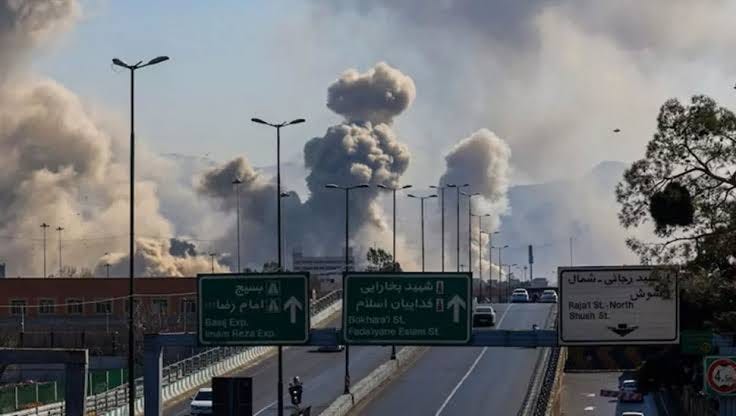
Whenever I go hiking and can see the horizon from the mountains, my mind also becomes ready to ask more basic questions. For example, while listening to an interview about the war, an analyst made a point about war industry that stayed with me, so I decided to research it when I got home.
Whatever Israel and Netanyahu may have said about Iran, and whatever decisions they made based on their apocalyptic politics, when an imperialist power goes to war with a country like Iran, its reasons go far beyond the claims of local political rivals or the familiar narratives of some defeated, increasingly Russophile sections of the Western left. Above all, war sets capital in motion.
Military production has itself become one of the engines of accumulation. War is no longer simply about taking territory or opening new markets. It has become a way of keeping capital moving. And this engine needs an enemy, or at least a permanent source of tension, that remains in place rather than being completely destroyed.
Militarism is an industry, and its products are bombs and missiles. These products need to be used up, while suitable regional and national security arguments must constantly be created to maintain their market.
The Middle East is the largest market for this industry. Saudi Arabia is the biggest buyer of American weapons, and its $142 billion agreement in 2025 was described as the largest arms deal in history. War pours fuel on this market and keeps the cycle turning from both directions. The missiles fired at Iran must be replaced, while Iran’s waves of missiles and drones create fresh demand for air defense systems. This means activating a huge range of basic industries.
This is not simply a matter of switching on the production lines of a few arms factories. Replacing this volume of missiles and drones, and building new defense systems, would activate main several industrial sectors, even under the most conservative estimate. These range from mining, steel, alloys and chemical industries to rocket engines, semiconductors, radar systems, infrared sensors, batteries, software and precision machining.
Once testing, communications, maintenance and the expansion of production lines are included, the network grows to between 15 and 20 industrial sectors. War does not only expand the market for weapons. It also ties a large part of basic industry and advanced technology to the arms economy.
During the first three months, Saudi Arabia purchased $9 billion worth of Patriot missiles, while the United Arab Emirates and Kuwait each bought more than $8 billion worth of air defense systems. The US military budget passed one trillion dollars, and companies such as Lockheed Martin and RTX received contracts to increase production. The enemy must remain so that demand can remain.
These orders do not simply increase the profits of a few major corporations. Based on the relationship between production and employment in the US aerospace and defense industries, every one billion dollars in annual demand can support around 1,600 direct jobs and more than 2,200 jobs once the supply chain is included.
This means that Saudi Arabia’s $142 billion agreement could probably keep between 15,000 and 30,000 people employed each year in weapons factories and their vast supplier networks, depending on how much of the production takes place inside the United States and how long the agreement lasts.
These are workers whose jobs, from mining and metalworking to chips, chemicals, rocket engines, radar systems and software, become tied to the war economy.
An air defense system such as the Patriot is produced through a transnational network. Missile production, control systems, electronic components and support services are divided among companies in the United States, Germany, Spain, Poland, Romania and Saudi Arabia.
Since the $142 billion agreement covers several military fields and involves more than twelve main contractors, it is reasonable to estimate conservatively that industries in at least ten to fifteen countries will be directly involved in its production, assembly and support.
Once minerals, computer chips, alloys, chemicals and other upstream suppliers are included, the network of the war economy probably extends across 20 to 30 mostly Western countries, or even more.
Dear friends, if you want to help develop and expand this work, please become a member on Patreon. I generally publish short comments here. For longer reports and articles, visit my blog. firenexttime.net